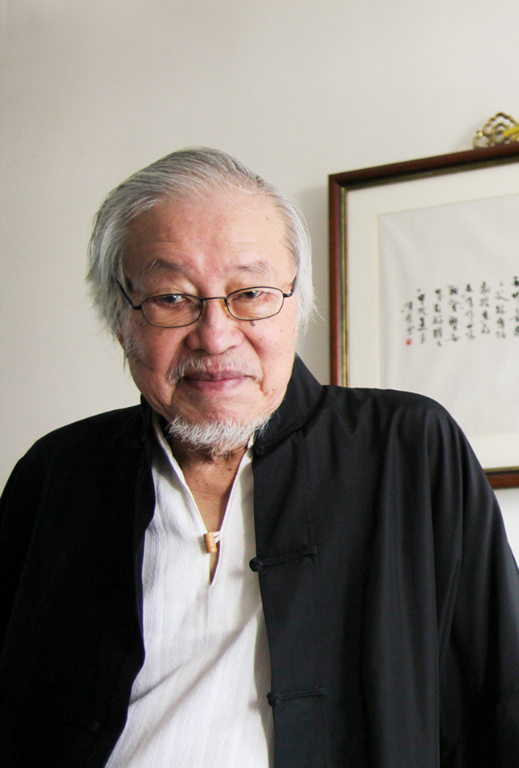
Doming Lam
林樂培
1926–2023
“The Father of New Music in Hong Kong”
Hailed as “The Father of New Music in Hong Kong”, Dr. Doming Lam was born in Macau in 1926, to a big family with 21 children. His Christian name was Domingos. While studying at the Seminário e Igreja de São José, he took up the violin, choral singing and conducting with Austrian priest Father Guilherme Wilhelm Schmid. Lam moved to Hong Kong in 1947 and assisted in the founding of the Sino-British Orchestra, where he played the violin. He also conducted church choirs at the Hong Kong Cathedral of the Immaculate Conception and the Rosary Church, where he created and directed a number of theatrical productions. He learnt the violin under Arrigo Foa and music theory under Maple Quon. After obtaining his ABRSM Grade 8 music theory exam in 1953, Lam furthered his study in Canada and received a diploma in Music Composition in 1958. From 1960 to 1964, he studied film music at the University of Southern California under Miklos Rozsa, a 3-time Oscar winner. Alongside his studies, Lam also interned in Hollywood.
Since the early 50s, Doming Lam committed himself to modernising Chinese music. “Search for roots in tradition, find ways in the avant-garde” was his famous motto. His name appeared in the “New Grove Dictionary of Music and Musicians”, making him one of the few early Chinese musicians to be included in the anthology.
Lam returned to Hong Kong after graduation. In 1965, he held his first solo composition concert at the City Hall Concert Hall – where Lam’s former violin teacher Arrigo Foa played The Oriental Pearl, a sonata for violin and piano. On the programme was the well-known pipa work Lament of Lady Zhao Jun re-arranged for the piano. Between 1965 and 1970, Lam worked at Rediffusion — the only TV and radio station in Hong Kong then — as a producer for cultural and entertainment programmes. In the 1980s, he produced a series of programmes on classical music for RTHK Radio 4 and TV section.
From 1970 to 1977, Lam was the Creative Director for Alpha Advertising. At the time, he was instrumental in founding the Asian Composers League (ACL) in 1973, and the Composers and Authors Society of Hong Kong (CASH) in 1977. He also founded the Hong Kong Composers Guild in 1983. In 1981, as Chairman of the ACL Hong Kong Chapter, he organised a conference which brought together composers from Mainland China, Taiwan and Hong Kong. It was a historic event that had been overdue for 30 years.
In 1988, with Lam’s initiation and directorship, the annual International Society for Contemporary Music (ISCM) World Music Days was held in Hong Kong for the first time. Organized jointly with the ACL World Music Days, the event brought together composers from Mainland China, Taiwan, Hong Kong, and two hundred additional composers from elsewhere around the world. This unprecedented event successfully put Hong Kong on the map as a hub of contemporary music.
Lam was an Honorary Consultant and Guest Conductor of the Hong Kong Chinese Orchestra. During the time he composed classics such as Autumn Execution and The Insect World. The latter was performed in 2002 by the Hong Kong Chinese Orchestra at the Goldener Saal in Vienna. These two compositions were part of the Orchestra’s tour repertoire in more than 20 cities. Another one of Lam’s compositions, Three Night Songs of Li-Po, featured soprano Barbara Fei, was the first contemporary Chinese work to be performed in Mainland China after the Cultural Revolution. Lam had also served as Music Directors of the Macau Chamber Orchestra (the then Macau Orchestra) and the Hong Kong Children’s Choir. Lam taught at the Music Department of the University of Hong Kong and was made its Composer-in-Residence from 1989 to 1994. In recognition of Lam’s contributions to the music scene, he was named ‘Composer of the Year’ by the Hong Kong Artists’ Guild in 1988. In the same year, he was awarded the ‘Medalha de Mérito Cultural’ by the Macau Government and the ‘Medal of Merit – Culture’ by the Macau SAR Government in 2002.
In 1999, Lam received the “Hall of Fame Award” from CASH. His compositions The Insect World and Moonlight over Spring River were awarded with CASH’s “Golden Sail Most Performed Works Awards – Local Serious Work” in 2006 and 2016 respectively. His string quartets Five Settings and Re-transformation of Xi-Pi were named “Best Serious Composition” in CASH’s Golden Sail Music Awards in 2010 and 2012 respectively.
In 2007, Lam was elected as an Honorary Member of the ISCM. In 2016, to celebrate Lam’s 90th birthday, a series of concerts and seminars were held in Hong Kong and Macau. In 2020, under COVID restrictions, the Hong Kong Academy for Performing Arts awarded him an Honorary Doctorate.
During his final years, while enjoying life with his grandchildren, Lam was still keenly devoted to writing music. One of his last compositions was Calm, a chamber work for Chinese ensemble. The piece has clean musical lines, conveying a sense of peacefulness and the state of being at ease, which aptly reflect Lam’s ethos. In his own words:
“Nothing should bother one’s mind. One is not affected by gain or loss. When faced with the external world, one always stays rational, grounded, and merciful. This is the natural state of mind.”
林樂培
Doming Lam
1926–2023
「香港新音樂之父」
人稱「香港新音樂之父」的林樂培博士,1926年在澳門出生;原名林嶽培(聖名Domingos),後改名為林岳培。他來自一個共有兄弟姐妹21人的大家庭。少年時他就讀澳門聖若瑟修院,跟隨司馬榮神父(Fr. Guilherme Wilhelm Schmid)學習小提琴、合唱和指揮。1947年來港,參加組建中英樂團,擔任小提琴手,同時參與堅道聖母無原罪主教座堂、尖沙咀玫瑰堂的合唱、音樂劇創作和演出。師從富亞(Arrigo Foa)學習小提琴、關美楓學習樂理;1953年考獲英國皇家音樂學院八級樂理,同年考進多倫多皇家音樂學院,1958年獲頒作曲文憑。1960至1964年到美國南加州大學,師從三屆奧斯卡金像獎電影音樂得主羅沙(Miklós Rózsa)學習電影作曲及配樂。
林樂培早於1950年代立志為中國音樂現代化。他的著名格言:「從古思中尋根、在前衛中找路」正好總結其音樂理念和畢生追求。他是少數先被列入《新葛羅夫音樂及音樂家辭典》的華人音樂家之一。
畢業回港後,於1965年在香港大會堂主辦個人作品專場,是華人作曲家的首次。音樂會由昔日恩師富亞演奏他的《東方之珠》小提琴奏鳴曲,同場亦有為鋼琴獨奏而改編的琵琶曲《昭君怨》。他於1965至1970年擔任麗的電視文化及綜合節目「青年聯誼會」和「麗的音樂會」的編導,1970至1977年任雅緻廣告公司創作總監,又為香港電台第四台及電視部製作多個深入民心的古典音樂節目。期間積極參與創辦亞洲作曲家同盟(1973年)、香港作曲家及作詞家協會CASH(1977年)、香港作曲家聯會(1983年)等音樂組織。他亦以亞洲作曲家同盟香港分會主席身份,於1981年籌劃海峽兩岸作曲家三十年來首次在香港的歷史會面。又於1988年在香港主辦「國際現代音樂協會」週年大會及音樂節,兩岸四地作曲家與二百位國際同行濟濟一堂,把香港載入現代音樂的國際版圖。
林樂培任香港中樂團名譽顧問和客席指揮,期間創作《秋決》、《昆蟲世界》等經典名曲。《昆蟲世界》更於2002年由香港中樂團在維也納金色大廳演出。另外,由費明儀擔任獨唱的《李白夜詩三首》,是文革後首部公演的現代作品。林樂培1983至1989年擔任澳門室樂團(澳門樂團前身)音樂總監,1983至1984任年香港兒童合唱團音樂總監。1989至1994年任教於香港大學音樂系,為「駐校作曲家」。為了嘉許林樂培對音樂界的貢獻,他1988年獲香港藝術家聯盟頒發作曲家年獎;同年獲澳門政府頒授文化功績勳章,2002年又獲澳門特區政府頒發榮譽獎狀。
1999年他獲CASH頒授音樂成就大獎。作品《昆蟲世界》和《春江花月夜》分別獲頒2006及2016 CASH最廣泛演出金帆獎之「本地正統音樂作品」獎、作品第二弦樂四重奏《五段錦》和《西皮再變》分別於2010年及2012年獲CASH金帆音樂獎「最佳正統音樂作品」。他於2007年獲選為國際現代音樂協會榮譽會員。2016年慶祝九十華誕,出席在港澳舉行的多場音樂會及研討會。2020年,香港演藝學院為他頒授榮譽博士學位。
林樂培晚年除了含飴弄孫,仍鍾情創作。代表作之一是中樂室樂小品《平常心》,音樂線條簡約,意境寧謐、安逸,反映老人心境豁達。正如他所說:
「念力當中沒有煩惱,不患得、不患失,面對外在的境界時,這念心都是在理智、在定力、在慈悲當中,這就是平常心。」